Thursday, June 19, 2014

Fifth time is the charm

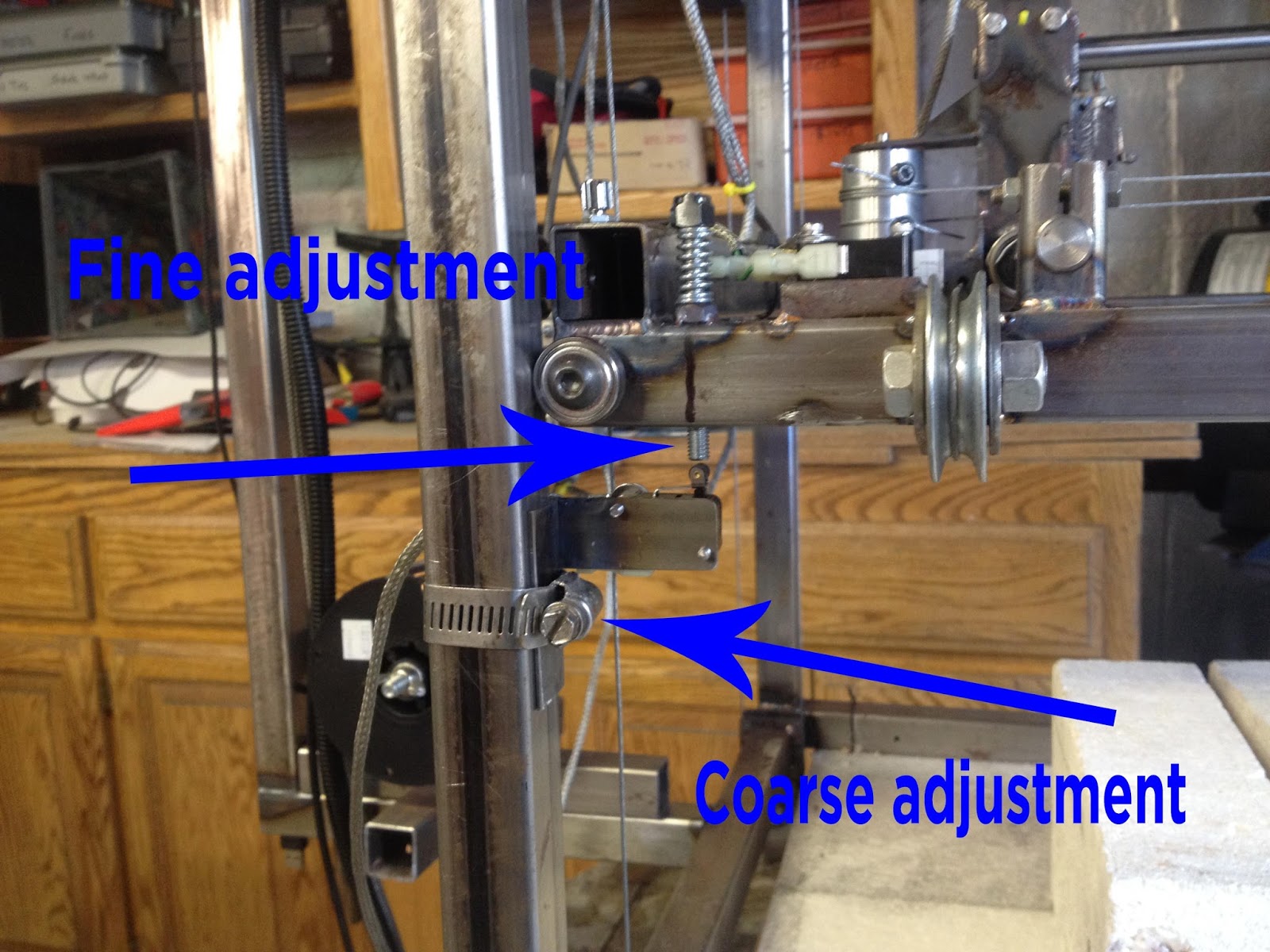
This is the fifth configuration change for the "Z" axis limit switch.
During the last round of weld testing it was discovered that the distance of the starting gap between the tungsten electrode and the build plate is crucial.
The initial size of the "air gap" was vital to how the first layer formed.
As is well known with all other types of 3D printing if the first layer goes wrong the rest of the print goes wrong.
As weld testing progressed it was found the "sweet spot" for the air gap to be plus / minus .25mm (.010")
The coarse adjustment was revision 4
Fine adjustment is revision 5
Monday, June 16, 2014

Summing up the methods it took to solve the transient voltage problem 
  1. All wires are shielded and terminated to common ground. This combines the ground between welder and robot.
  2. All electric lines follow a parallel path. An example would be having the welding return follow the torch input line. In all my years of welding this is the first time this technique has been needed. 
  3. To be used in industrial environment the current generation of low voltage motion control drive boards for 3D printers will need some form of protection circuitry between the board and motors and/or limit switches. Preferably as close to the board as possible. In my case there was a direct path from the limit switches to the processor chip. The surge at welder start up created a voltage spike in the switch circuit and caused the processor to reset. 

Sunday, June 15, 2014

Shielding the torch lines.
The idea was originally to try and control the transient voltage leaking from the torch input and use the shield to ground the machine movements to the welder chassis.

This photo shows how to use a screw driver to open an entry into the braid.

Torch with shield added.
When my electrical engineer friend Geoff Dolan saw the machine he suggested using the shield as return path from the build plate to the welder. This strategy keeps the return path parallel to the input and as short as possible. A great suggestion although I had to resize the shield to handle the amp load. 

Friday, June 13, 2014

The transient voltage problem seems to be resolved.
The 2 major updates to the machine are :
Implemented the circuit protection scheme David McQuate suggested.
A grounding buss is added so it is easy to implement all components to a common ground.


One of the motivators
driving the creation of this project is to create an affordable welding robot that can be taught to weld better then me. A machine that is happy to weld hour upon hour and only asking to be fed in small quantities of electricity and production consumables. A machine that won't be distracted the myriad of fun stuff a human would rather engage in every second of every day.

This belt buckle was recently rediscovered in the closet. It is something I hand welded at a NASA launch facility 35 years ago. The "Scout" missile was the smallest and most reliable satellite launching system making it the perfect delivery vehicle for the original constellation of GPS satellites.

Maico is a German off-road motorcycle. The base material is .062" thick 304 Stainless steel with .062" filler rod.
If I were to create another today I'm confident the craftsmanship and welds would look similar.


Tuesday, June 3, 2014

A transient voltage problem
created by the welder arc start cycle has been slowing the machine build progress.  I know there is a solution but not being strong in electrical engineering has left me poking in the dark for answers. One of my Linkedin connections, Michael Fitzpatrick suggested contacting his friend David McQuate at Clear Stream Technologies for assistance.
David rode across town yesterday on his Easy Racer recumbent bike to examine the machine.
After studying the driver board  schematic and the machine he made several suggestions.
He suggested adding this circuit to the limit switches to stop the voltage intrusion.
Each limit switch will need the addition.
Hopefully this will turn a corner in the design and the pace will pick up.